The Essence of Effective Management Reporting in 2025
In the world of financial management, management reporting is essential for maintaining full control over your management reports. A clear overview of financial and operational data helps CFOs make informed decisions, identify trends in a timely manner, and optimize their organization’s strategy. In this blog, we explore the key aspects of effective management reporting and show you how you can further improve it with smart dashboards and real-time insights.
Reading time: 2 min.
What is management reporting?
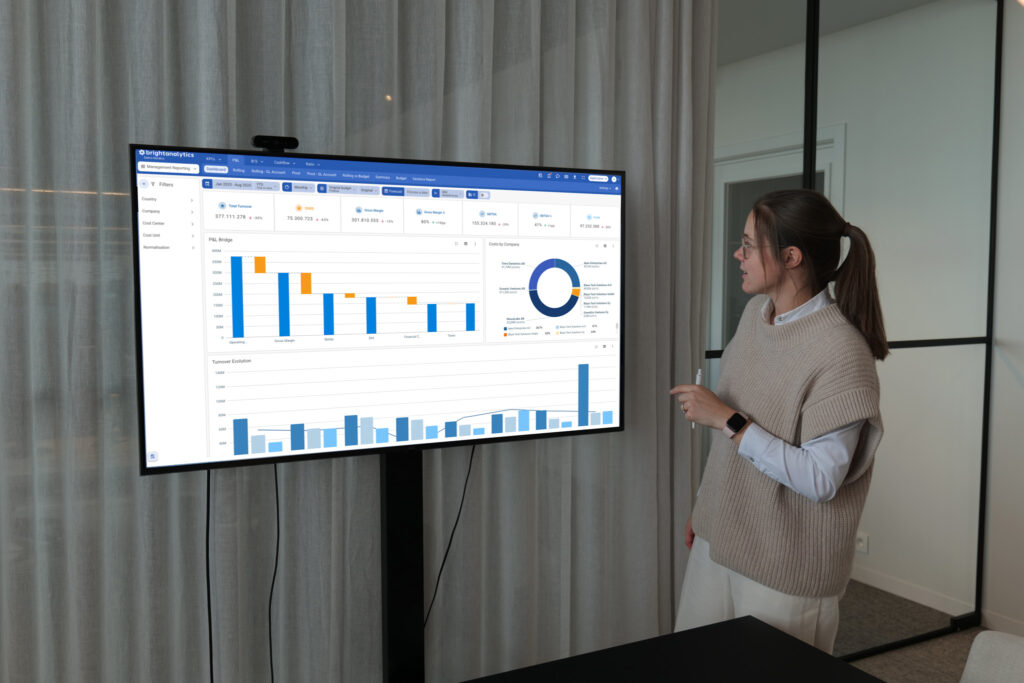
Management reporting is more than just a collection of numbers. It is the process of compiling, analyzing, and clearly presenting financial and operational data so that CFOs and decision-makers can quickly gain insight into their organization’s performance. It provides both a look back at the past and a reliable foundation for future planning. With modern tools such as BrightAnalytics, these reports become real-time and visually intuitive, making complex data immediately understandable and enabling strategic decisions to be made more quickly. This allows CFOs to capitalize on opportunities, mitigate risks, and steer the organization toward its goals.
Key Challenges and Considerations in Sales Reporting
For many CFOs, it is a challenge to gain a complete picture of their organization’s financial and operational health. Traditional reports are often scattered across multiple systems and require a lot of manual processing, which is time-consuming and increases the risk of errors. In an environment where real-time insight and reliable data are essential, there is a need for a solution that is both efficient and reliable.
Traditional Reporting and Its Limitations
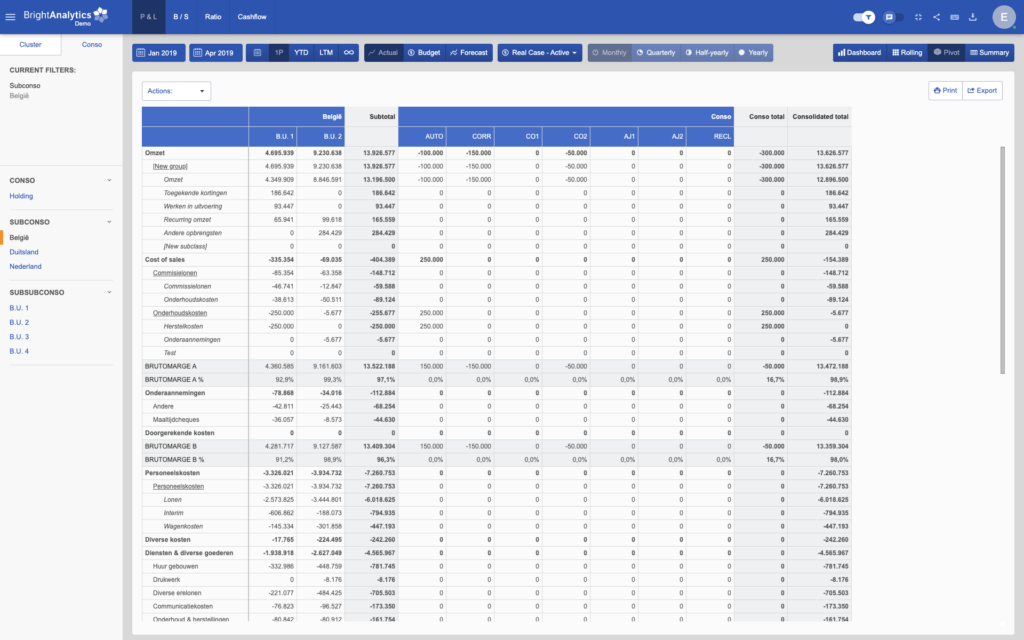
Every day, CFOs work with reports such as income statements, balance sheets, cash flow statements, budget versus actual reports, KPI reports, forecasts, consolidation reports, and operational dashboards. These reports often require manually consolidating data from different systems, making them error-prone and time-consuming.
BrightAnalytics replaces these static reports with interactive dashboards that provide immediate insight into the numbers. For example, an income statement can be converted into a visual dashboard that shows revenue, costs, and profit by department at a glance. Balance sheets can be easily compared across multiple entities and periods, while key ratios are calculated automatically. Real-time cash flow dashboards give CFOs immediate insight into revenue and expenses, enabling them to make investment or payment decisions more quickly and reliably.
Budget versus actual figures are updated dynamically; KPIs such as revenue growth, customer retention, and project margins can be tracked in a single overview; and forecasting dashboards help predict future results based on historical data. Consolidation reports from multiple entities are automatically combined, and operational dashboards display real-time metrics such as inventory levels or project statuses, enabling immediate course corrections.
Real-time overviews at all times on a single platform
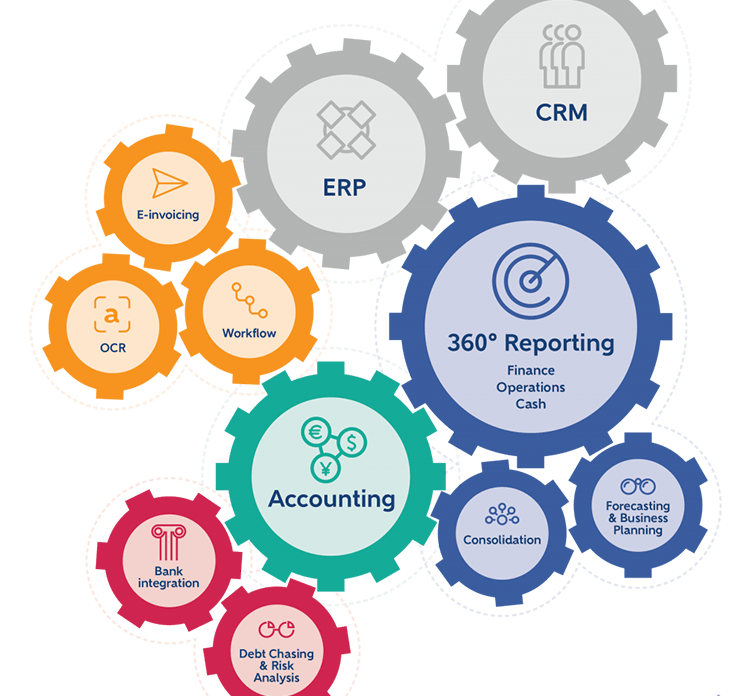
BrightAnalytics brings all financial and operational data together in a single, easy-to-use platform and integrates seamlessly with accounting systems, ERP solutions, and CRM tools. CFOs and their teams gain immediate access to key insights, enabling them to make faster, more informed, and more strategic decisions. Automating routine tasks saves time, reduces the risk of errors, and gives CFOs more time to focus on analysis and strategy. Thanks to its flexibility and scalability, the platform is suitable for both medium-sized and large organizations that want to manage complex data efficiently.
Get started easily with full control
BrightAnalytics is intuitive and requires no extensive training or technical knowledge. CFOs can easily request a demo and immediately experience how the platform provides real-time insights into financial and operational data and optimizes management reports. Users retain full control over what is displayed on the dashboard, ensuring it aligns perfectly with their priorities. This way, the CFO remains in the driver’s seat, while the platform supports data-driven and efficient decision-making.